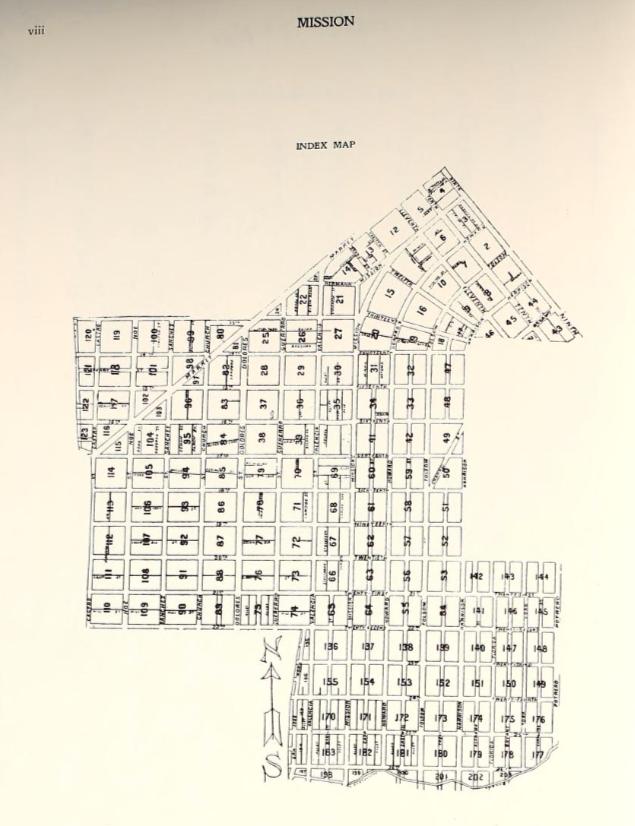
Horner’s Addition
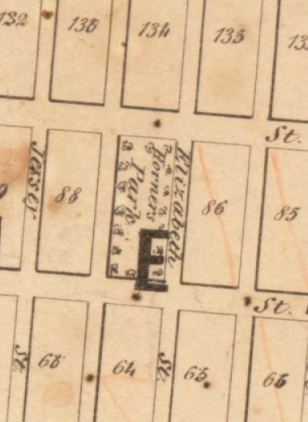
“Subdivision of blocks in ‘H.A.’ [Horners Addition] as per map made for John M. Horner by J.J. Gardiner, City & Co. Surveyor, A.D. 1854 on January 1st.”: ms. map on sheet 20 x 25.5 cm., mounted on lower half of lithographed map”For particulars refer to large map at J. M. Horners Office, Armory Hall, Montgomery St.” MS notes: Map of Horners addition Rancho de San Miguel or Noe Rancho. A copy of this map filed at the request of A. C. Thayer Nov 11, 63, 22 min past 10 O’clock. Rbbs 173 to 180 are now located on the new maps of the City…. Prime meridian: GM. Relief: no. Graphic Scale: Feet. Projection: Cylindrical. Printing Process: Lithography. Verso Text: MS notes: 442362 Horners Addition. Map of San Francisco with Horners Addition
Soon after [the purchase of Potrero Nuevo] we bought a confirmed grant containing near five thousand acres, and paid for it two hundred thousand dollars. This land is situated just above the last purchase (the Potrero) and it is now a part of the city of San Francisco. We spent considerable money on this land in surveys, fencing and improvements. Some six hundred acres adjoining the city, as it then existed, we laid out in lots, blocks and streets, and made them conform to those already laid out by the city. We named the streets, which names are still retained, and the property is assessed as situated in “Horner’s Addition,” and in a separate set of books from other city property. The above includes about all of our real estate purchased in California up to 1854. […] The country was in a wild state, not a tree or bush upon the land to be used, fencing to be hauled 25 miles over a natural road bed, bridges, none except what we made ourselves over brooks, rivers and slough. Indians were our first workmen. Thirty miles had to be traveled to get either blacksmithing or milling done, and seventy-five miles to reach a market. The walls of houses were made of sundried brick, joists and rafters were (in some cases) dragged 25 miles over rocks and gravel part of the way, which wore away much of the stick before reaching their destination; no nails, spikes or hinges were to be had, raw hide must answer instead, sheeting was fastened to the rafters with raw hide and the doors were hung with raw hide hinges in some cases. A cart, even such as high-toned ladies (Spanish) often rode in (and there was no dispute about their being ladies, educated, and with the manners and politeness of a Chesterfield), were made entirely of wood and raw hide, no nails, spikes, rivets or bolts were to be had for the purpose. The wheels were hewn out of solid logs, the spokes, hubs, felloes and tire were one piece, the wheel left a track on the ground when in motion, six or eight inches wide, and was from two and one-half to three and one-half feet high, the frame of the body was made of hewn timber, as was the axle-tree, the stakes were round poles about six feet high with other poles lashed horizontally to the stakes with raw hide strings, a bullock hide laid on the bottom, answered for bottom boards to the cart and another stretched tightly across the top of the stakes served as a sunshade, sometimes the inside was lined temporally with costly red blankets, which made the inside look nice and cosy. The ox yokes were without bows, made of a straight stick three by six inches square, five and one-half feet long, straight with the exception of a small curve near each end to fit the upper part of the oxe’s neck near the horns. This stick was lashed to the head and horns of the ox, just back of the horns, by a long strip of raw hide one and one-half inches wide. A substitute for ox chains was raw hide. Fences were made of stakes set in the ground and poles lashed to them horizontally with raw hide. The usual way of driving two or more yoke of oxen was, one man on horseback to lead and stop the team when required, two more men on horses, one on each side equipped with a long sharp stick to punch up the oxen, and make them follow their leader, and one in the cart, also armed with a sharp stick to prick up the rear span, should they require it. To turn the team to the right prick or scare the left hand ox to make him step ahead of his mate, this turns their heads to the right, as the yokes being tightly fastened to their heads, when one’s head turns, both heads turn. […] The position I held in the community at this time made me much sought after as an endorser of notes, a signer of bonds and a leaner of money to the impecunious. As I had been raised in a purely rural District of New Jersey and unacquainted even in theory with the “tricks of trade”, the evil effects of note endorsement or loaning money without adequate security, I loaned and endorsed freely, hoping to do good thereby. I have no recollection of refusing anyone who asked for an accommodation or requested to have their note endorsed up to and including 1853. Such was our [position] when the first wave of money panic struck California, and swept over America with such disastrous results from 1853 to 1859. […] Yet how small is this large sum, when compared to the direct and indirect loss endured by the whole people during these years of panic. The loss of my property placed me financially where I had commenced seven years before, as nothing of much value was saved from the wreck, except my experience, my prospects even were dark, cloudy and discouraging. I gave up my carriage team and my watch from my pocket, and commenced physical labor again to support my family. I did the best I could, the panic ceased, and its evil effects wore gradually away from the country. I rented my old homestead and after a time bought it again, this making the fifth time I had purchased it, the paying for it was slow work.
Daily Placer Times and Transcript - January 10, 1854
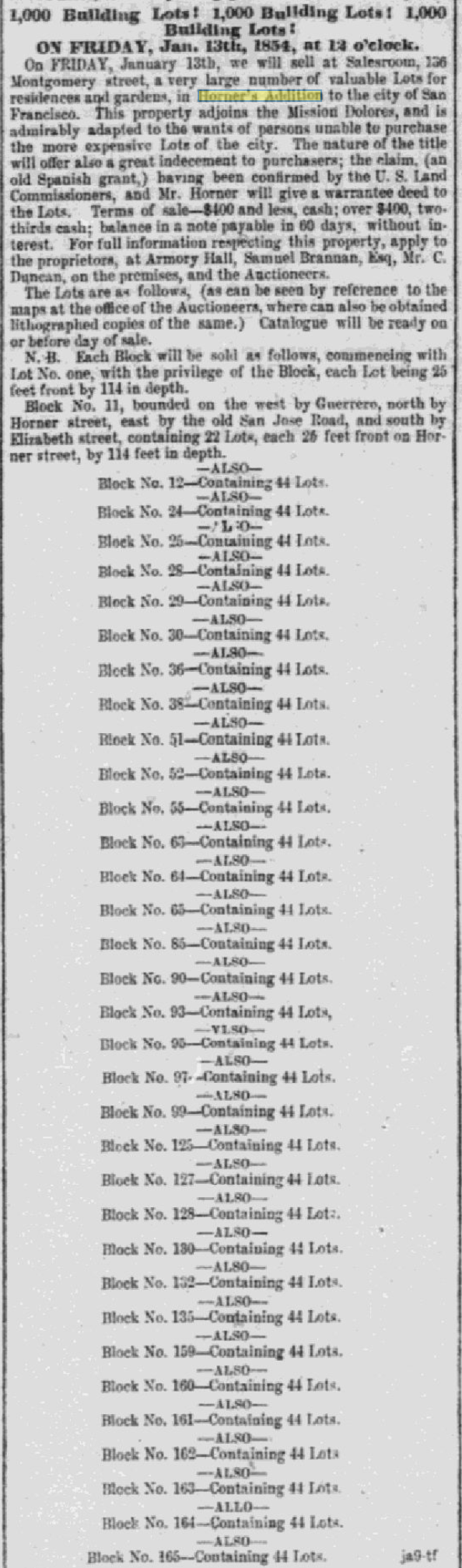
1,000 Building Lots! 1,000 Building Lots! 1,000 Building Lots! ON FRIDAY, Jan. 13th, 1854, at 12 o’clock. On FRIDAY, January 13th, we will sell at Salesroom, 136 Montgomery street, a very large number of valuable Lots for residences and gardens, in Horner’s Addition to the city of San Francisco. This property adjoins the Mission Dolores, and is admirably adapted to the wants of persons unable to purchase the more expensive Lots of the city. The nature of the title will offer also a great inducement to purchasers; the claim, (an old Spanish grant,) having been confirmed by the U. S. Land Commissioners, and Mr. Horner will give a warrantee deed to the Lots. Terms of sale—$400 and less, cash; over $400, two-thirds cash; balance in a note payable in 60 days, without interest. For full information respecting this property, apply to the proprietors, at Armory Hall, Samuel Brannan, Esq, Mr. C. Duncan, on the premises, and the Auctioneers. The Lots are as follows, (as can be seen by reference to the maps at the office of the Auctioneers, where can also be obtained lithographed copies of the same.) Catalogue will be ready on or before day of sale. N. B. Each Block will be sold as follows, commencing with Lot No. one, with the privilege of the Block, each Lot being 25 feet front by 114 in depth. Block No. 11, bounded on the west by Guerrero, north by Horner street, east by the old San Jose Road, and south by Elizabeth street, containing 22 Lots, each 25 feet front on Horner street, by 114 feet in depth. “Advertisement.” Daily Placer Times and Transcript (San Francisco, California) V, no. 1164, January 10, 1854: [3]. NewsBank: San Francisco Chronicle Historical Archive. https://infoweb-newsbank-com.ezproxy.sfpl.org/apps/news/document-view?p=EANX-NB&docref=image/v2%3A11B56327F72F7EE7%40EANX-NB-11BE41F06A163738%402398229-11BE41F097B82C90%402-11BE41F12843C510%40Advertisement.
Daily Placer Times and Transcript - January 30, 1854
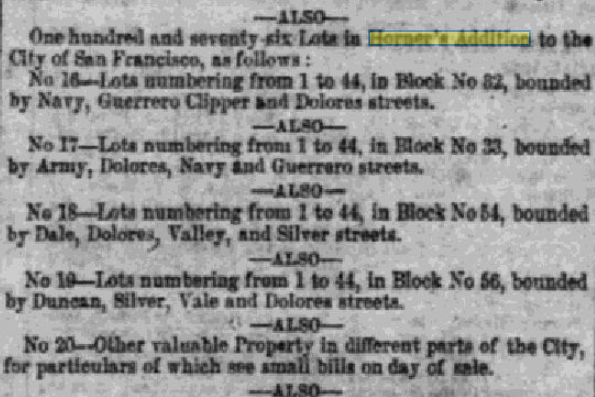
—ALSO— One hundred and seventy-six Lots in Horner’s Addition to the City of San Francisco, as follows: No 16—Lots numbering from 1 to 44, in Block No 32, bounded by Navy, Guerrero Clipper and Dolores streets. —ALSO— No 17—Lots numbering from 1 to 44, in Block No 33, bounded by Army, Dolores, Navy and Guerrero streets. —ALSO— No 18—Lots numbering from 1 to 44, in Block No 54, bounded by Dale, Dolores, Valley, and Silver streets. —ALSO— No 19—Lots numbering from 1 to 44, in Block No 56, bounded by Duncan, Silver, Vale and Dolores streets. “Advertisement.” Daily Placer Times and Transcript (San Francisco, California) V, no. 1181, January 30, 1854: [3]. NewsBank: San Francisco Chronicle Historical Archive. https://infoweb-newsbank-com.ezproxy.sfpl.org/apps/news/document-view?p=EANX-NB&docref=image/v2%3A11B56327F72F7EE7%40EANX-NB-11BE41D774A0E680%402398249-11BE41D7A3999620%402-11BE41D85EA93670%40Advertisement.
Daily Placer Times and Transcript - March 31, 1854
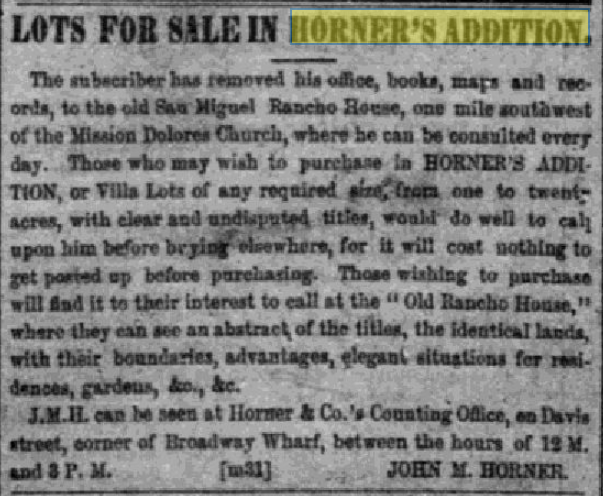
LOTS FOR SALE IN HORNER’S ADDITION. The subscriber has removed his office, books, maps and records, to the old San Miguel Rancho House, one mile southwest of the Mission Dolores Church, where he can be consulted every day. Those who may wish to purchase in HORNER’S ADDITION, or Villa Lots of any required size, from one to twenty acres, with clear and undisputed titles, would do well to call upon him before buying elsewhere, for it will cost nothing to get posted up before purchasing. Those wishing to purchase will find it to their interest to call at the “ Old Rancho House,” where they can see an abstract of the titles, the identical lands, with their boundaries, advantages, elegant situations for residences, gardens, &c., &c. J.M.H. can be seen at Horner & Co.’s Counting Office, on Davis street, corner of Broadway Wharf, between the hours of 12 M. and 3 P. M. JOHN M. HORNER. “Advertisement.” Daily Placer Times and Transcript (San Francisco, California) V, no. 1233, March 31, 1854: [2]. NewsBank: San Francisco Chronicle Historical Archive. https://infoweb-newsbank-com.ezproxy.sfpl.org/apps/news/document-view?p=EANX-NB&docref=image/v2%3A11B56327F72F7EE7%40EANX-NB-11BE421B52BC3038%402398309-11BE421B6DB074F8%401-11BE421BCB82BB48%40Advertisement.
Daily Alta California, Volume 5, Number 142, 23 May 1854
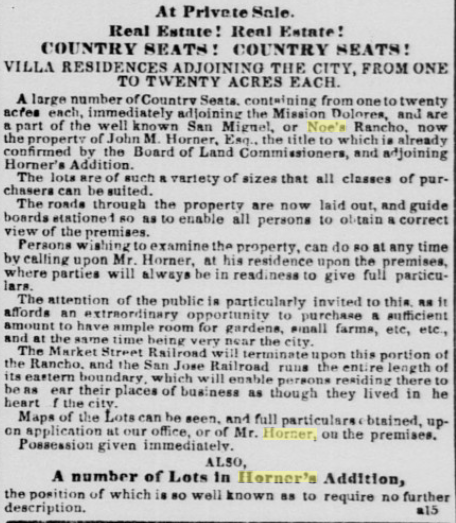
At Private Sale. Real Estate! Real Estate! COUNTRY SEATS ! COUNTRY SEATS ! VILLA RESIDENCES ADJOINING THE CITY, FROM ONE TO TWENTY ACRES EACH. A large number of Country Seats, confining from one to twenty acres each, immediately adjoining the Mission Dolores, and are a part of the well known San Miguel, or Noe’s Rancho, now the property of John M. Homer, Esq. the title to which is already confirmed by the Board of Land Commissioners, and adjoining Homer’s Addition. The lots are of seen a variety of sizes that all classes of purchasers can be suited. The roads through the property are now laid out, and guide boards stationed so as to enable all persons to obtain a correct view of the premises. Persons wishing to examine th» property, can do so at any time by calling upon Mr. Homer, at his residence upon the premises, where parties will always be in readiness to give full particulars. The attention of the public is particularly invited to this, as it affords an extraordinary opportunity to purchase a sufficient amount to have ample room for gardens, small farms, etc., etc., and at the same time being very near the city. The Market Street Railroad will terminate upon this portion of the Rancho, and the San Jose Railroad runs the entire length of its eastern boundary, which will enable persona residing there to be as near their places of business as though they lived in the heart of the city. Maps of the Lots can he seen, and full particulars obtained, upon application at our office, or of Mr. Horner, on the premises. Possession given immediately. ALSO, A number of Lots in Horner’s Addition, the position of which is so well known as to require no further description.
These ads run until the end of January 1855.
But in the interim, the Panic begins:
Daily Alta California, Volume 5, Number 320, 18 November 1854
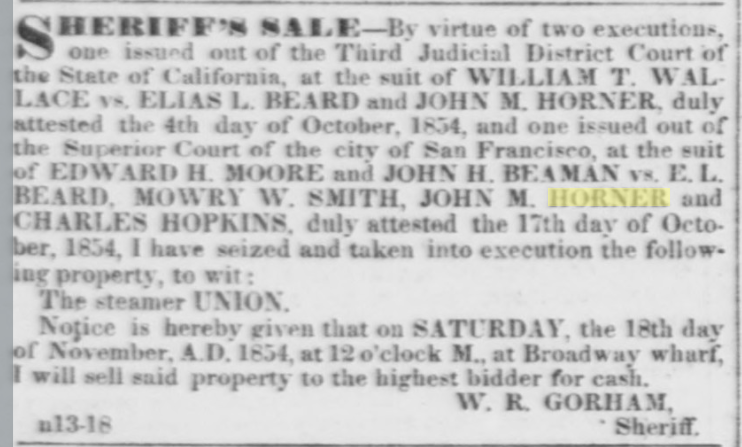
Huh I guess it took awhile to get this sorted out…
Daily Alta California, Volume 5, Number 335, 4 December 1854
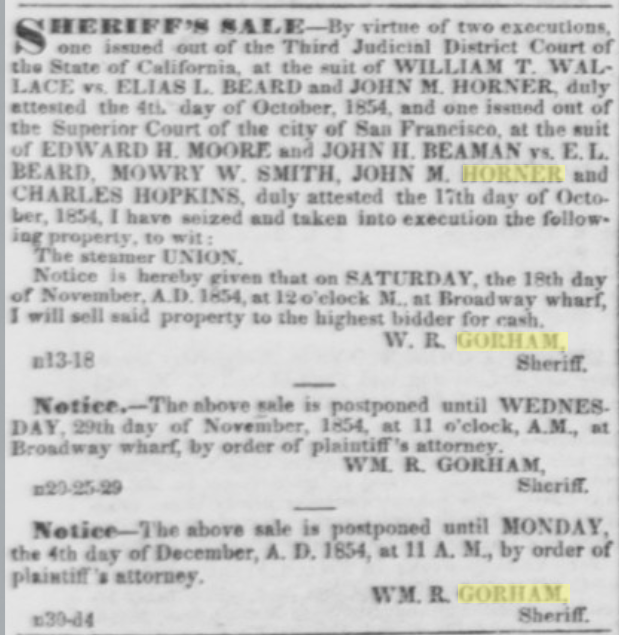
and then, I guess it wasn’t enough?
Daily Alta California, Volume 6, Number 8, 9 January 1855
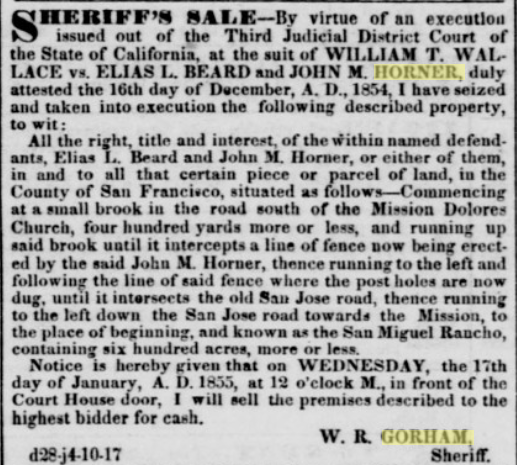
Hmm, and this appears on Feb 1, nominally the day after…?
Daily Alta California, Volume 6, Number 31, 1 February 1855
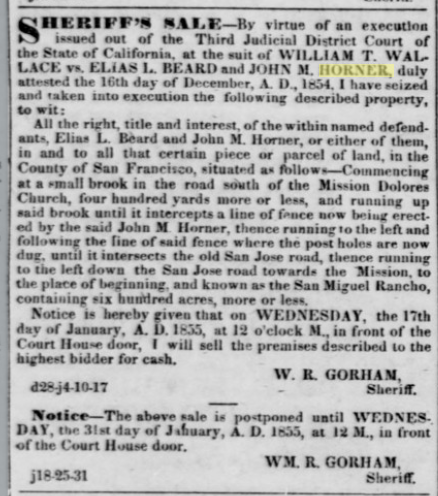
Ah dang, here it is…
Daily Alta California, Volume 6, Number 317, 15 April 1855
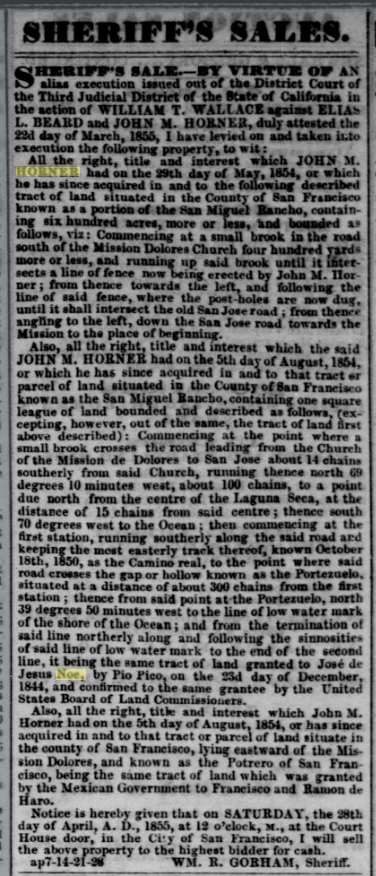
SHERIFF’S SALE - By VIRTUE OF AN alias execution issued out of the District Court of the Third Judicial District of the State of California in the action of WILLIAM T. WALLACE against ELIAS L. BEARD and JOHN M. HORNER, duly attested the 22d day of March, 1855, I have levied on and taken into execution the following property, to wit : All the right, title and interest which JOHN. M. HORNER had oa the 29th day of May, 1854, or which he hasince acquired in aad to the following described tract of Und situated in the County of San Francisco known as a portion of the San Miguel Rancho, containing six hundred acre, more or less, bad bounded as follows, viz: Commencing at a small brook la the road south of the Mission Dolores Church four hundred yard more or less, and running up said brook until it intersects a line of fence now being erected by John M. Homer ; from thence towards the left, and following the line of said fence, where the post-holes are now dug. until it shall intersect the old San Jose road ; from there angling to the left, down the San Jose road towards the Mission to thplace of beginning.
Also, all the right, title and interest which the said JOHN M. HORNER had on the 5th day of August, 1854, or which he has since acquired in and to that tract ax parcel of land situated in the County of San Francisco known as the San Miguel Rancho, containing one square league of land bounded and described a follows, (excepting, however, out of the same, the tract of land first above described): Commencing at tbe point where a small brook crosses the road leading from the Church of the Mission de Dolores to San Jose about 14 chains southerly from said Church, running thence north 69 degrees 10 minute west, about IUO chain, to a point due north from the centre of the Laguna Seea, at the distance of IS chains from said centre ; thence south 70 degrees west to the Ocean ; then commencing at the first station, running southerly along the said road acd keeping the most easterly track thereof, known October 18th, 1850, as the Camino real, to the point where said road crosses the gap or hollow known a the Portezuelo. situated at a distance of about 300 chains from the nrtt station ; thence from said point at the Portexuelo, north 39 degrees 50 minutes west to the line of low water mark of the shore of the Ocean ; and from the termination of said line northerly along and following the sinnositir> of said line of low water mark to the end of the second live, it being the name tract of Und granted to Jose de Jesus Noe, by Pio Pico, on the S3d day of December, 1844, and confirmed to the same grantee by the United States Board of Land Commissioners. Also, all the right, title and interest which John M. Homer had on the sth day of August, 1854, or bas since acquired in and to that tract or parcel of land situate in the county of San Francisco, lying eastward of the Mission Dolores, and known as the Potrero of San Francisco, being the same tract of Und which was granted by the Mexican Government to Francisco aud Ramon de Haro. Notice is hereby given that on BATURDAY, the 28th day of April, A. D., 1855, at 12 o’clock, at the Court House door, in the City of San Francisco, I will sell the above property to the highest bidder for cash.
- WM. R. GORHAM, Sheriff
Presumably Pioche and Robinson bought it, or the remaining parts of it, on that day.
San Francisco Bulletin - December 31, 1862
DELINQUENT TAX SALE.—The sale of property for delinquent taxes was resumed yesterday morning, commencing with Schedule No. 6, “Horner’s Addition,” and in the course of the day all the property subject to sale under the remaining schedules was disposed of. Property which has been sold and the bids thereon not paid, will be re-sold on Friday next, commencing at 11 o’clock. “Delinquent Tax Sale.” San Francisco Bulletin (San Francisco, California) XV, no. 71, December 31, 1862: [3]. NewsBank: San Francisco Chronicle Historical Archive. https://infoweb-newsbank-com.ezproxy.sfpl.org/apps/news/document-view?p=EANX-NB&docref=image/v2%3A113ACFC4DAF84818%40EANX-NB-117B344D19857668%402401506-117B344D8025E338%402-117B344ED95A8A20%40Delinquent%2BTax%2BSale.
Renumbering
Horner’s Addition in the 1906 block book. You’ll note that those ones retain their original Horner numbers.
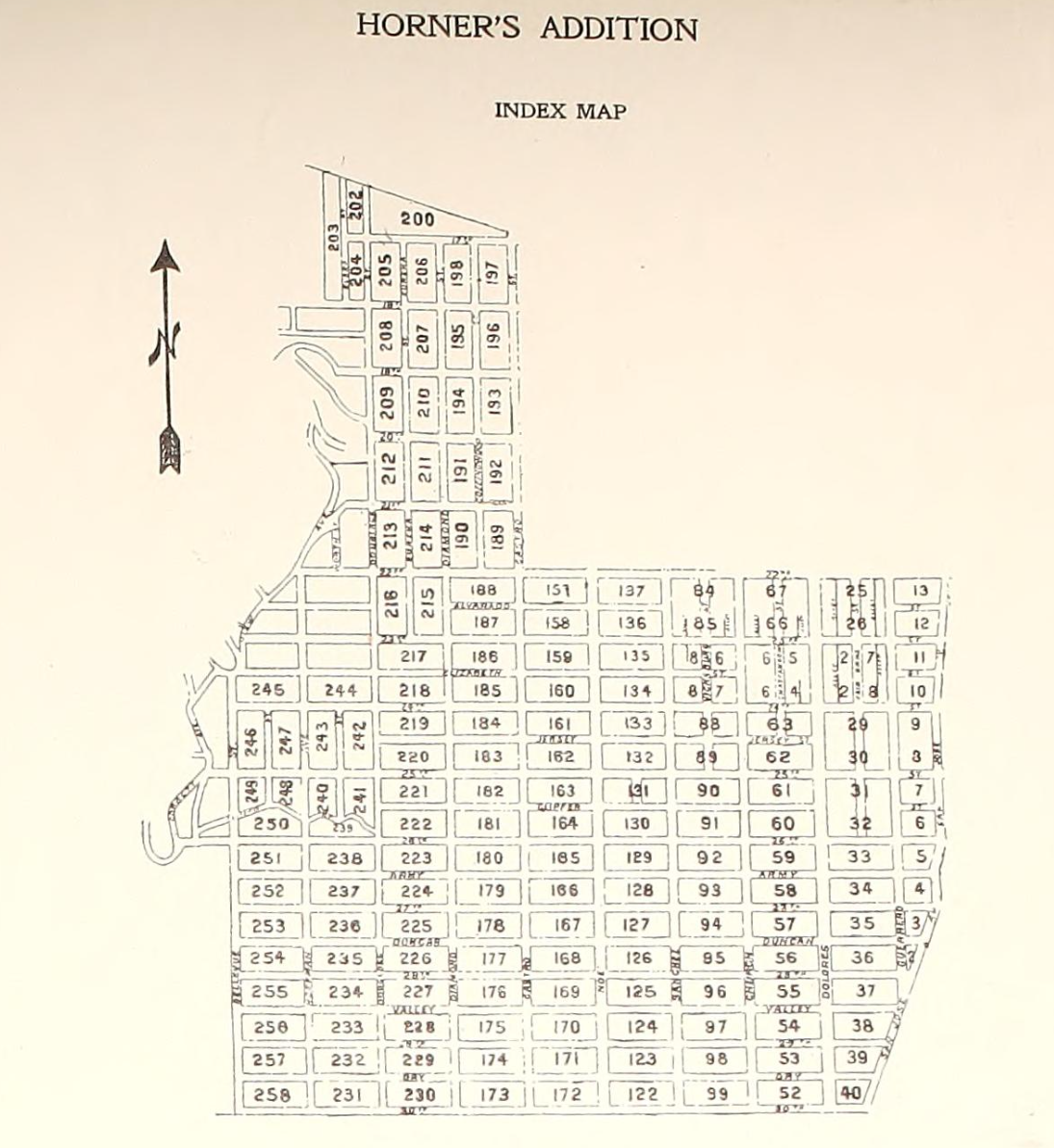
At some point a big chunk of Horner’s Addition was chopped off to become the “Mission Block” area, including Hartford St.