John Meirs Horner
b. June 15, 1821 d. May 14, 1907 (in Hawaii)
Arrived in CA in 1846 on the Brooklyn with Sam Brannan. Originally a teacher in New Jersey, began farming in Mission San Jose in 1847, bought 30,000 acres from Pio Pico and put it to the plow, making immense profits which he in turn invested into more land. Founded Union City, and lived along its north edge - then known as Centerville.
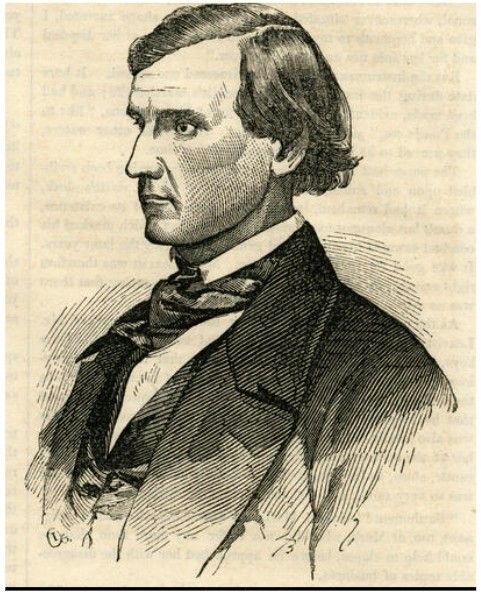 1854 engraving from Gleason’s Pictorial Drawing Room Companion “Mr. Horner, the Greatest Farmer in California.”
- Established a commission house (store) in San Francisco, under the firm name of J. M. Horner & Co., to sell their own and others’ produce.
- We secured by purchase the steamer Union to carry our produce to market.
- First agricultural fair. (And second)
- Flouring mills not being sufficient in California at this time, we built one at Union City, with eight run of burrs, at a cost of eighty-five thousand dollars, and ground our grain and that of others.
- We equipped and ran a stage line in connection with our steamer, as far up the valley as San Jose, twenty-five miles. Thus completing a through passenger line from San Francisco to San Jose. We opened sixteen miles of public roads, mostly through our own land, and fenced the larger part on both sides.
He writes a letter to the editor of the Daily Alta California on 9 July 1851, and it’s printed 14 July:
California Agriculture. The letter which we publish below, from an intelligent practical farmer, is worth whole volumes of newspaper articles upon the subject of our agricultural resources. Here is a mass of facts, going over a series of years, and demonstrating, beyond the possibility of doubt, the certainty that California, rich as she is in mines, is infinitely more valuable in other important respects. It is extremely gratifying to us, who have always contended in favor of the State’s great facilities for agriculture, to be enabled to lay before our readers, both upon the Pacific and the Atlantic, so reliable and convincing a statement. AT MY FARM NEAR EX-MISSION DE SAN JOSE, SANTA CLARA VALLEY, July 9, 1851. Messrs. Editors: — I observed, in the Weekly Tribune of March 15th, an extract from the Journal of Commerce concerning farming operations in California, which refers particularly to me in fact, but not in name. My name, as recorded, is John M. Horner, born June 15th, 1821, Monmouth County, New Jersey, where my father and his family now reside. I left New York Feb. 4th, with my wife, two weeks after marriage, for California, to farm; going by the way of Cape Horn and the Sandwich Islands, and bringing my farming utensils with me. I arrived in California in August, 1846, since which time I have been pursuing one steady aim at agricultural pursuits. FIRST YEAR — I farmed sixty acres in various kinds of produce, but gathered nothing but dear experience. SECOND YEAR — I was thrown into confusion on account of the gold mines. Help could not be hired at any price, and I am credibly informed that the Governor himself had to cook his own meals. I farmed but very little, and finally I caught the gold fever and went to the mines; and there I caught the fever and ague, and returned to my farm. I gathered nothing the second year. THIRD YEAR — I made farther preparations for farming. I was determined not to be disappointed, but farm I would. I could not hire hands for $16 per day. I tried to enter into co-partnership, but could not effect it; all had rather go to the mines. None of my brothers were yet in the country. But I would not be disappointed. I got the assistance of three Indians, and we went to the mountains, 25 miles distant, and there we worked at the red-wood (cedars of Lebanon, for some of them are 300 feet high.) until we got rails and posts sufficient to secure fifteen acres, which I planted principally in potatoes. The produce gathered was worth about $16,000; but unfortunately I lost one half, on account of heavy rains setting in, and the scarcity of help. Thus ended the third year. FOURTH YEAR — My younger brother arrived in January. We managed to fence some 400 acres and farm 150, principally in potatoes; and our crop yielded about as fellows: Potatoes …….. 1,760,000 lbs. Pumpkins …… 80,000 lbs Onions ………. 40,000 “ Barley ……….. 20,000 “ Tomatoes …… 50,000 “ Wheat ……….. 40,000 “ Beets …………. 6,000 “ Chickens …… 100 “ Solid-headed cabbages ……. 60,000 “ Eggs …………. 500 doz FIFTH YEAR, 1851 — We have fenced about 1,300 acres; and have farmed 800. We want no rain until December, and we will be sure to gather, of Potatoes ……….. 120,000 bush . Solid-headed cabbages ………….. 108,000 lbs Onions …………. 6,000 “
Table beets ……. 4,000 “ Chickens …………. 600 Turnips …………. 1,000 “ Eggs ……………….. 1,200 doz Carrots ………….. 1,000 “ Onion seed ………. 800 lbs. Tomatoes ………. 1,200 “ Beet “ ……… 200 “ Barley …………… 5,000 “ Cab’ge “ ………. 100 “ Pumpkins ………………… 30 tons. To most of the Eastern world who are unacquainted with our soil and climate, the above account will look almost impossible. But, considering that we have nine months out of twelve in which wo can sow, and nine in which we can gather, it is not doubtful. And if there ever was a country in which the “ploughman overtook the reaper,” California is that one. A large amount of produce will be raised in California this year for market. This valley alone will yield about 600,000 bushels Potatoes, 6,000 bushels Pears, . 32,000 “ Onion, 1,400 “ Apples, 10,200 “ Table Beets, 400 tons Pumpkins, . 5,000 “ “ Tomatoes, 195 “ Grapes, 100,000 “ Barley, 3,000 “ Hay, . 15,000 “ Wheat, 550,000 Solid headed Cabbages. Besides the above, there will be a great quantity of beans, peas, melons, and finer garden sance; and some 4,000 sheep and hogs, besides cattle almost as numerous as the acres of land over which they feed. This valley, if its resources were fully developed, would supply more than a million of population. I write from a knowledge of the facts, having spent five years in the valley. There are 600,000 acres of good tillable land within its borders. The poorest will yield 2,000 pounds of wheat or barley, and the best 70,000 pounds of onions, per acre. Notwithstanding the present prices of labor, which are about $70 per month, my calculations, based upon experimental knowledge, are such as to warrant me in stating that California can supply her own market in beef, pork, flour, barley, and all kinds of vegetables, as cheap, and of a better quality, than she can be supplied from any quarter of the world. Vegetables will be very cheap this year. I am credibly informed that Mr. Steinberger has purchased the best article of California potatoes, for the supply of the ocean steamers, for the year, at 3 cents per pound. After the first of August, 1852, California will supply her own market with barley; but when she can supply herself with flour, is doubtful, as there are no mills in the country, and farmers will not raise wheat without some prospect of a market. Yours respectfully, JOHN M. HORNER.
Daily Alta California, Volume 2, Number 290, 28 September 1851
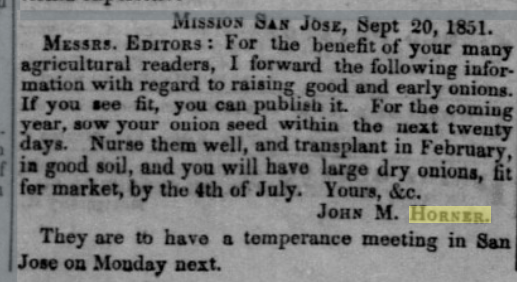
Mission San Jose, Sept 20, 1851. Messrs. Editors : For the benefit of your many agricultural readers, I forward the following information with regard to raisiug good and early onions. If you see fit, you can publish it. For the coming year, sow your ouion seed within the next twenty days. Nurse them well, and transplant in February, in good soil, and you will have large dry onions, fit fer market, by the 4th of July. Yours, &c. John M. Horner. They are to have a temperance meeting in San Jose on Monday next.
Similar puffery about the quality of California flour can be found in the Daily Alta California, Volume 4, Number 340, 29 December 1853 And a note about shade trees Daily Alta California, Volume 5, Number 70, 12 March 1854
the unsettled state of land titles rendered investments in land almost as hazardous as depositing money in commercial banks, as we found to our cost. The United States opposed all land titles. and requested proof of their genuineness to be made before its land commissioners, reserving the right of appeal to its district court, in the event the commissioners decided against the government; and to appeal again to its supreme court, if the district court decided against it. Thus years of costly law suits, and in some cases ruin to owners of land titles, intervened before final settlement. We suffered from the law’s delay in settling titles, and from squatters keeping from as, by force, a goodly portion of our lands, being encouraged to do so by the government; for as long as the government withheld final confirmation, the squatter continued to hold possession, however good the title. We suffered more mentally and financially during these years from the above named causes, than from all floods and four-footed animals in former years.
Purchased some part of Rancho San Miguel from Jose de Jesús Noé in mid 1853 and called it “Horner’s Addition”. This was when the land and titles were all very confused with the delayed conversion of the Californio lands.
“In San Francisco county, we paid two hundred and eighty-five thousand dollars for five thousand two hundred and fifty acres of land adjoining the city of San Francisco, and expended nearly eight thousand dollars upon it in surveys, fences and other improvements. One thousand and fifty acres of these lands we surveyed and staked into streets, blocks, and lots, extending the streets of San Francisco over it. It is now, and has been for over thirty years, a part of that flourishing city.” —John M. Horner
He says a large number of squatters devalued his property:
[…] the closer these squatters could get to San Francisco, the better they liked it; and if the land was surveyed and staked into streets, blocks, and lots, the better, as then they could and did sell lots cheap to innocent parties.
Basically, with the owners living in Union City, there was little or nothing that could be done to prevent some random guy from setting up shop and selling the lots to unwary newcomers.
There is an interesting account of the early days of the development of Horner’s Addition in the writings of Caroline Barnes Crosby who lived with the Horner’s during 1854 and 1855. One the accounts read:
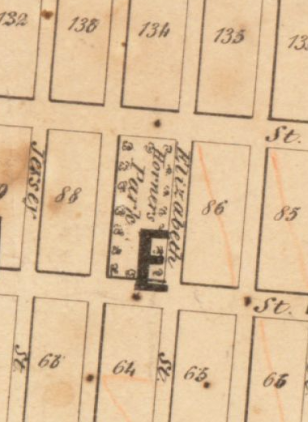
“Sun 29th [January 1854] A beautiful pleasant morning. . .Alma Frances and myself took a walk over the hills, to take a view of br Horners new purchase, and to get a peep at the Spanish house where we expect to reside, after a few weeks. We admired the scenery very much; and think in short time it will be a great place. We walked from bluff to bluff untill we arrived at the top of a high one nearly in front of the dobie house where the spaniard resides of whom Mr H bought the land. We then sat down to admire the prospect. And we came to the conclusion that altho it was not quite retired, yet it was a most beautiful and romantic place. . .” [pages 239-240]
Started Horner’s Addition, but very few lots sold.The Panic of 1854-7 took out his and his brothers’ investments.
…the first wave of money panic struck California, and swept over America with such disastrous results, from 1853 to 1859. […] thousands of tons of farm products were never sent to market, for there was no sale; good potatoes were ten cents per bushel, but there were no ten cents All this happened in the Golden State of California, in 1854, where millions of gold and silver were dug from its mines every month. Most, or all, of it was sent to San Francisco as soon as produced, and tons of it were hoarded in banks, treasury vaults, napkins, old bonnets, and other places, thought safe to keep money, after drawing it from the banks. Gold was gloated over and worshiped. A man with a few hundred dollars in gold coin was independent, while the owner of scores of thousands of property was poverty stricken, and permitted it to be sold for taxes, and in some cases never redeemed it. Some with ready money held it for purchasing properties at the depreciated rates for which it was sold by the sheriff, and money could not be borrowed on real estate, however good the title.
Ended up in “The Sandwich Islands” (Hawaii) because he heard from Spreckels that there were about to be large sugar cane plantations started in Maui. So thither went he and the rest is history.
…At this time my oldest son was cultivating sugar cane in the Hawaiian Islands, and hearing that Mr. Claus Spreckels was about to open the largest sugar plantation known, he advised us to see Mr. Spreckels and get a contract from him to cultivate cane for him. If we could do so, he thought, we would do better in the Islands than in California. We saw Mr. Spreckels, and contracted with him to go to the islands and cultivate cane on shares. In fulfillment of this contract we sold our farms, chartered a schooner, and placed there in our families—eighteen souls—our household eflects, horses and farming tools, and started for the islands, where we arrived on the 25th of December, 1879.
https://en.wikipedia.org/wiki/John_M._Horner https://www.foundsf.org/index.php?title=The_Farmer_with_the_Golden_Plow:_John_Meirs_Horner_(1821-1912) https://imagesofoldhawaii.com/john-meirs-horner/
Certainly was an opinionated old coot in his dotage.
National finance and public money; settling the money question; government ownership of railroads and telegraphs; by J. M. Horner AND Some Personal History of the Author
Archive.org produced an OCR, and I’ve excerpted his autobiography here.
Voyage of the Ship Brooklyn, by John M. Horner from Improvement Era Aug 1906 Part 2 of same, Sept 1906
Excerpted in text form here
Excerpted from California and Californians Vol 4 1926 by Rockwell D. Hunt and Nellie Van de Grift Sanchez
JOHN MEIRS HORNER At the first agricultural fair in John Meirs Horner was awarded the silver medal and officially given title of Pioneer Farmer of California His experiences and achievements are of extraordinary interest in the history of the state He was born on a farm in Monmouth County New Jersey June 15 1821 He lived there to the age of twenty one securing a good school education but his bent was always in the direction of farming For several years he hired out to a farmer for 9 a and also taught school Then while continuing his teaching during time he spent several summers in the West as far out as Iowa Kansas seeking a favorable place for farming Not finding as regarded as good opportunities in the West he returned East in and married a neighbor’s daughter They took their honeymoon on lengthy sea voyage around Cape Horn by way of the Juan Island and the Hawaiian Islands and after six months on the sea traveling 18,000 miles they arrived in California On reaching they first learned that war had broken out between the United States Mexico At San Francisco was collected a little community of forty people called Yerba Buena Going to lower San Joaquin Mr Horner sowed forty acres of grain and harvested a good crop next year 1847 he moved to a more favorable situation at San Jose In 1848 he rented a piece of land from an Indian built a two room house and while it was necessary to guard his crops almost night and day the incursion of wild animals he made a profit from his venture In October and November 1849 came the gold hunters to by land and sea and they craved nothing more than vegetables Mr Horner was the only farmer who had an abundance of vegetables for sale The newcomers traveled from the mines 200 miles distance to wagon loads of produce at fair prices His first crop in 1849 8,000 In 1850 his brother William came by way of the Isthmus was made a partner in the business They enclosed and farmed 500 acres that year the total volume of sales aggregating 150,000 Onions sold at 40 per hundred tomatoes at 300 per ton and potatoes at 150 per ton To sell their crop in 1850 they opened the commission house JM Horner & Company in San Francisco In 1851 they bought steamboat The Union to carry produce to market and that year did business of more than 275,000 In 1853 the potato crop was in excess of 22,000,000 pounds besides 1,500 acres of wheat barley cabbages onions and tomatoes The Horners built a flour mill at Union City at a cost of 85,000 and they also equipped and ran a stage line in connection with the steamer as far as San Jose Due to their enterprise fifteen miles of road were opened and these remained traveled thoroughfares into modern times During 1851 52 they purchased 450 acres then known as Potereo Nuevo and soon afterward bought 5,000 acres adjoining for 200,000 in the Potereo district Six hundred acres were laid out in lots and streets and JM Horner gave the names which have for the most part since been retained This was called Horner’s Addition No planting of and bushes had been made and fencing material had to be hauled twenty five miles It was very difficult to secure nails spikes or hinges rawhide was made to answer the purpose instead The Indians were mechanics making carts saddles shoes and houses and also did of the agricultural labor in the fields In 1857 came the panic which completely destroyed the agricultural promise and prosperity development by Mr Horner Thou sands of tons of farm produce were never sent to market Potatoes offered for 10 cents per bushel Millions of gold and silver were dug from the mines in California and tons were hoarded in banks treasury vaults The man with a few hundred dollars in gold was inde pendent while the owner of property that cost hundreds of thousands of gold was hard up and in many cases he allowed his property to sold for taxes That property costing Mr Horner 280,000 was away to pay a 40 endorsement and in the end he was back at the condition financially that he had started seven years previously Even his watch had gone in the settlement of debt About the same time occurred illness which robbed him of one of his daughters and he himself was sickened with lockjaw and his life was despaired of for several months After recovering he took a to build a bridge over the Alameda River for the county and 300 from it Finally in 1879 Claus Spreckles contracted with JM Horner to go to the Sandwich Islands and cultivate sugar cane on the shares he recovered himself financially and in time had developed another for tune estimated at around half a million For many years he was associated in business with his brother William Y Horner who February 21 1898 John M Horner himself died at Honolulu in 1902 at the age eighty one His life story of which the above is a very record was written out by himself and published at the end of a volume which he wrote on the financial history of the Hawaiian Islands The children of John M Horner were Josephine Horner Blacow of Alhambra California Albert Horner and Robert Horner both in Honolulu Mrs Frank W Taylor of 4455 Park Boulevard Oakland and William Horner who died in 1925 and was born in 1847 one of first American native sons of California
1850 (date unk)

26 July 1852

“California, San Francisco County Records, 1824-1997,” database with images, FamilySearch (https://familysearch.org/ark:/61903/3:1:33S7-95NM-9LB9?cc=1402856&wc=319V-RMW%3A20726201%2C20821501 : 20 May 2014), Land and Property Records > Deed Index, Vol. 02, A-Z, 1850 > image 150 of 412; San Francisco Public Library, California.

16 oct 1854 - horner to ph ellis Deeds vol 45, pg 236

30 oct 1854 - horner to alfred higgins, deeds vol 48 pg 15

9 nov 1854 - horner to jos ervington - deeds vol 44 p 609

21 nov 54 - horner to wn n jones (sales and atty?) 47 deeds 264

25 nov 54 - horner to TW lane - deeds 49 p 53

Jan 12 1855 - horner to noe??? satisfaction of mortgage - 6 rels 271

20 jan 1855 - horner to william o andrews - deed 50 271

1 march 1855 - horner by atty to Jas cloughe - 48 deeds pg 405

6 mar - horner to AG Randall(s?) - 48 deeds 413
 8 mar 1855 - horner to jas clough - 48 deeds 430
 21 mar - horner to Geo W J Carter - 48 deeds 472
 10 apr horner to Thomas j williams - 52 deeds 134
 16 apr - horner to horner - 51 deeds 502 (or bill of sale misc c 577?)
 25 apr - the sheriff sale - agreement 3 cov? cor? 152 Jacoby and [D]rischfeld(?)

 “California, San Francisco County Records, 1824-1997,” database with images, FamilySearch (https://familysearch.org/ark:/61903/3:1:3QS7-L9FH-3F12?cc=1402856&wc=319L-7M9%3A20726201%2C1588621527 : 20 August 2015), Land and Property Records > Deed Index, Vol. 7A, 1854-1855 > image 214 of 323; San Francisco Public Library, California.